How to track event attendance from RSVP to the sponsor report
By the MyWrap teamNov 26 2026
Guide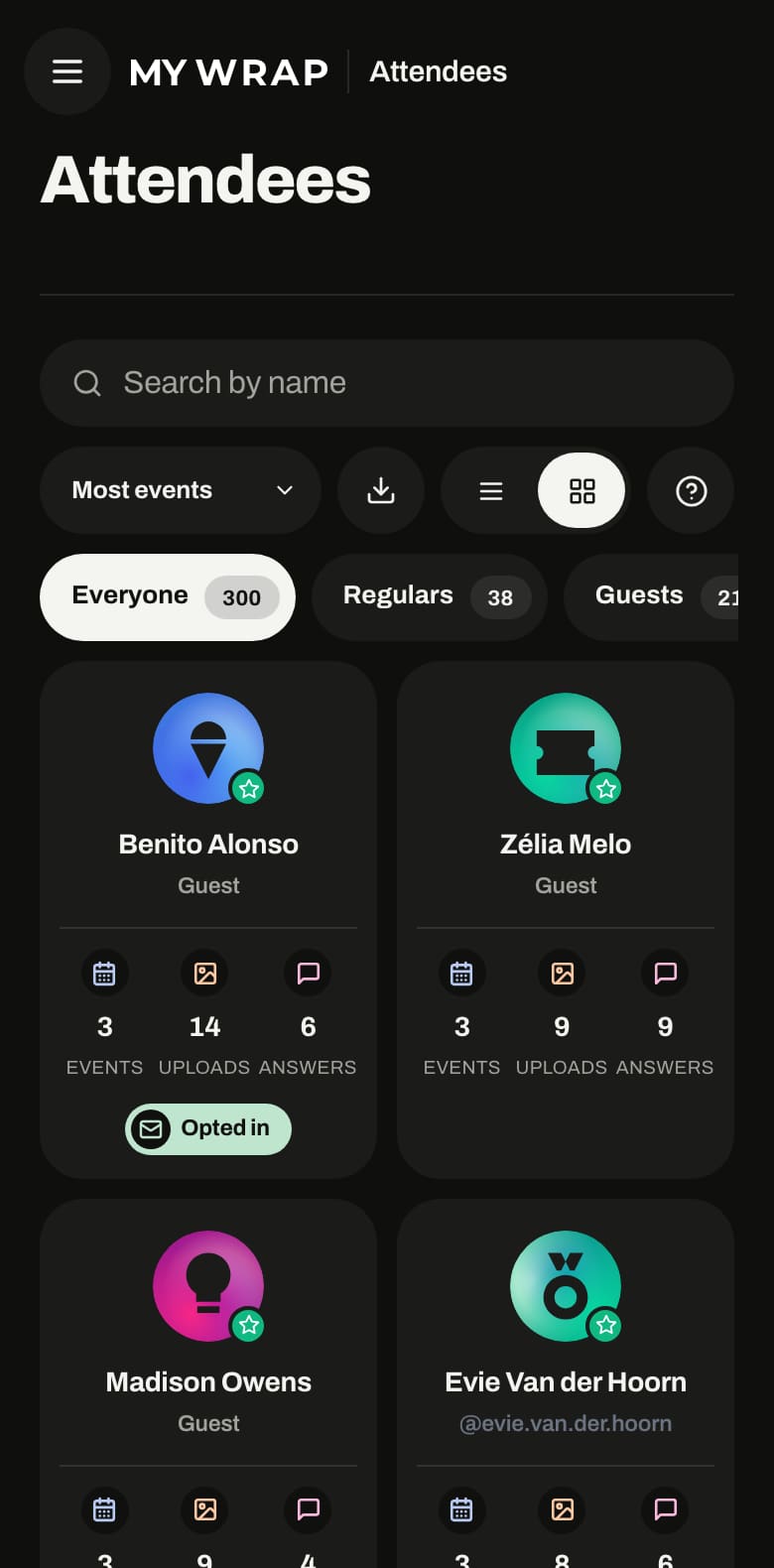
Track four numbers: RSVPs, tickets, check-ins at the door and people who took part. Check-ins are your real attendance, the gap between RSVPs and check-ins is your no-show rate, and people who took part is the number sponsors care about most. Count returning guests by matching names or emails across events.
Eight steps to attendance numbers you can stand behind
Step 1
Decide which four numbers you're counting
"How many people came?" has at least four honest answers. RSVPs are people who said they'd come. Tickets are people who paid, or claimed a free ticket. Check-ins are people who actually arrived. People who took part are guests who did something: answered a question, added a photo, voted in a poll.
Each one is useful. The trouble starts when they get mixed up, and a flyer says 400 when 400 was the RSVP count and 210 walked in. Write all four down for every event, label them, and you'll never have to defend a number you can't back up.
Step 2
Treat RSVPs as a forecast
RSVPs are for planning food, staff and space. They are a bad measure of attendance because saying yes costs nothing. For a free event, plan on 50 to 70% of yes RSVPs showing up. A "maybe" is worth about a quarter of a yes.
You can raise the show rate. Send a reminder two days out and another the morning of, with the address and start time in the first line. Ask people who can't make it to say so, which frees space for your waitlist and makes the yes count more honest. On MyWrap, guests answer Going, Maybe or Can't make it, so you see all three.
Step 3
Count tickets apart from comps
Tickets are firmer than RSVPs because money or at least a claim changed hands. Even so, split them: paid tickets, free tickets, and comps for speakers, staff, sponsors and press. Comps matter for capacity and they show up at a different rate, usually lower.
For paid events, 10 to 20% no-shows is normal, and more for cheap tickets bought months ahead. Keep the count by ticket type so you can see whether early bird buyers turn up as reliably as people who bought last week.
Step 4
Check people in at the door
This is your real attendance number, so make it easy to collect. Every guest gets a pass, staff scan or tap it at the door, and the count updates live. Plan one person checking in for every 75 to 100 guests who arrive in the first half hour, because that's when the line forms.
Paper lists work for 40 people. Past that, use phones: MyWrap's door check-in runs from any phone with a pass per guest and a live count, so two volunteers can work two doors and the totals still add up. Decide ahead what happens to walk-ins and plus ones, and log them too.
Step 5
Count the people who took part
Check-ins tell you who arrived. Participation tells you who was paying attention. Count guests who answered a poll, rated a session, entered a raffle, added photos or videos, or opted in to hear from you again.
A good participation rate for a social event is 40 to 60% of check-ins. Lower than 25% usually means the ask came at the wrong moment or took too many taps. One question as people join beats five questions at the end, when half the guests are looking for their coats.
Step 6
Work out your no-show rate
No-show rate = (RSVPs or tickets minus check-ins) divided by RSVPs or tickets. If 300 said yes and 186 checked in, your no-show rate is 38%.
Track it per event type, because a Tuesday panel and a Saturday party behave nothing alike. After three or four events you'll have your own number, and it's worth far more than any industry average. Use it to set capacity: if your no-show rate is 38%, you can safely take about 150 RSVPs for a space that holds 100.
Step 7
Count returning guests
Returning guests are the clearest sign an event is working. To count them you need something that matches across events: an email, a phone number or a sign-in. Names alone fail fast, because there are a lot of Sarahs.
Report it as a share of check-ins: "31% of guests had been to one of our events before." Then split by how many times, because five people who've come to every event since spring are your community, and worth a personal thank you.
Step 8
Report attendance to sponsors
Sponsors read attendance as a stand in for reach, so give them the honest version with labels. Lead with check-ins, then participation, then what guests did for the sponsor: answered their question, opted in to hear from them, tapped their link.
Say where each number came from and keep RSVPs out of the headline. A sponsor who learns your 400 was RSVPs will discount every other number you send. Send it within a week, in one place. A MyWrap debrief puts who came, feedback, opted-in contacts and link taps on one page, which saves you building the report by hand.
Lines to copy
Three lines to copy into your planning sheet, your reminder and your sponsor report.
[Event], [date]: [number] RSVPs, [number] tickets ([number] paid, [number] comps), [number] checked in, [number] took part. No-show rate [share].
See you [day] at [start time], [address]. Your pass is here: [link]. Can't make it anymore? Tap Can't make it so someone on the waitlist gets your spot.
[Number] guests checked in at the door and [number] took part. [Number] answered your question, [number] asked to hear from you and [number] tapped your link. [Share] had been to one of our events before.
Questions
How do you track attendance at an event?
Check every guest in at the door with a pass and a live count, and keep RSVPs, tickets and check-ins as separate numbers. Then count people who took part in polls, photos or opt-ins.
What is a normal no-show rate for events?
Free events often lose 30 to 50% of yes RSVPs. Paid events usually lose 10 to 20%. Your own rate after three or four events is the one to plan with.
How do I reduce no-shows at a free event?
Send reminders two days before and the morning of, make it easy to say you can't come, run a waitlist, and ask for an email or phone so the RSVP feels like a commitment.
How do I count returning attendees?
Match an email, phone number or sign-in across events, then report returning guests as a share of check-ins. Names alone are too unreliable.
What attendance numbers should I give sponsors?
Check-ins first, then people who took part, then what guests did for the sponsor, like answering their question or tapping their link. Label where each number came from and leave RSVPs out of the headline.
In the Help Center
Can guests RSVP on my event page?Where do I see feedback and analytics?How do I show a sponsor what their event did?Try it on your next event
One link for guests. Contacts, feedback and a debrief for you.